Empathy Lab
Empathy Lab is an international project run by Fundacja Leonarda together with partner organizations from Italy and Spain under the Erasmus+ Small-scale Partnerships in Youth (KA210-YOU) program. The project runs from October 2025 to March 2027 and focuses on developing empathy, countering discrimination and strengthening human rights education among young people.
The project started on October 1, 2025 and will run until March 31, 2027. Over 18 months, we are jointly creating tools, materials and educational spaces that help young people and those who work with them to develop empathy, better understand the mechanisms of discrimination, and respond consciously to stereotypes, prejudice and disinformation.
Empathy Lab combines human rights education, anti-discrimination education, empathy building, critical thinking and storytelling. We pay particular attention to young people living in smaller towns and in areas further away from large cities.
Why Empathy Lab?
We live in a world where access to information is practically unlimited, but that does not automatically make it easier for us to understand one another. Disinformation, stereotypes, simplified messages about different social groups and growing polarization can mean that instead of dialogue there is distance, distrust and sometimes open hostility.
Young people from smaller towns in particular may have fewer opportunities for direct contact with people from other cultures, with other experiences or lifestyles. Their knowledge of diversity is then built mainly on the media, the internet and the messages circulating in their immediate surroundings – and these do not always show the full picture.
That is why in Empathy Lab we want to combine knowledge with experience. On the one hand, we talk about human rights, discrimination, stereotypes and disinformation; on the other, we look for educational methods that let people change perspective for a moment, hear another person’s story and reflect on their own beliefs.
Empathy does not mean we have to agree with everyone. It does mean being willing to try to understand another person’s experience. And that is exactly the skill we want to develop.
What do we want to achieve?
Through Empathy Lab we want above all to:
- develop empathy as a practical tool for countering discrimination, intolerance and hate speech,
- increase young people’s knowledge of human rights, equal treatment and the mechanisms of discrimination,
- develop critical thinking and the ability to recognize disinformation and stereotypical messages,
- support educators, trainers, volunteers and youth workers in running activities on empathy and inclusion,
- create educational methods that can be used both in person and online,
- build cooperation between youth organizations, educators, NGOs and local communities in Poland, Italy and Spain.
From idea to practice – the stages of Empathy Lab
The project is designed as a process in which each activity builds on the previous one. We start by gathering knowledge and existing methods, then create our own tools, train people who work with young people and test the solutions we have developed, and in the final stage we give more space to young people themselves.
October 2025 – March 2027: coordination and international cooperation
Throughout the project, Fundacja Leonarda coordinates the partnership. We meet online regularly, monitor progress, share out tasks, consult on emerging results and make joint decisions about next steps.
Fundacja Leonarda is responsible for coordinating the whole project, while the Italian organization LUMiA ETS plays a special role in monitoring the quality of activities and results.
As a result, Empathy Lab is not a collection of separate events but a single process carried out jointly by organizations from three countries.
January 2026: Kick-off Meeting in Poland
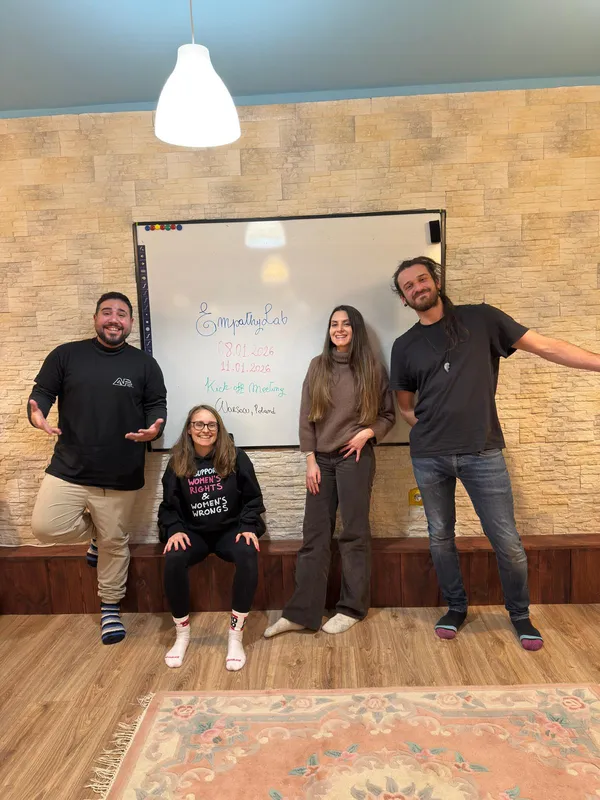
One of the first important moments of the project was the international partner meeting in Poland in January 2026.
Representatives of Fundacja Leonarda, LUMiA ETS and YEP met to discuss in detail the project timeline, the division of responsibilities, and how we will communicate and monitor results.
It was also a moment to talk about how we understand empathy and how we want to teach it. The partners bring different experience in non-formal education, youth work, storytelling, human rights and social action. This diversity is one of the project’s most important resources.
2025/2026: building the knowledge base
One of the first concrete results of the project is the Resource Database – a knowledge base on human rights, anti-discrimination, inclusion and disinformation.
We have gathered in one place materials, publications, reports, educational tools, videos and other resources that may be useful to people working with young people – you can find it at the bottom of this page.
The database will remain available after the project ends, so it will not be a one-off result but a resource that can continue to be used.
Spring–summer 2026: from research to the Empathy Toolkit
The next stage is Research and Development of Empathy Education and Anti-Discrimination Methodologies.
The partners analyzed existing methods, publications and good practices in empathy education, anti-discrimination, human rights education, working with diversity and critical thinking.
Based on the materials gathered, one of the main results of the whole project is being developed – the EmpathyLab Toolkit.
We already have a working draft, which we are reviewing and developing together. Above all, the Toolkit is meant to be practical: rather than staying at the level of theory, it will contain concrete exercises, methods and session plans that you can bring into your own work with a group.
It will include activities based on storytelling, perspective-taking, discussion, simulations, case studies and non-formal education methods. We also want the proposed methods to be adaptable to different groups and educational contexts.
October 2026: international training course in Rimini
The next step is moving from creating materials to using them in practice.
In October 2026, in Rimini, Italy, an international training course will take place for youth workers from Poland, Italy and Spain.
During the training, participants will explore and test methods for developing empathy and for working with topics related to discrimination, human rights and inclusion. An important part of the program will also be creating a safe space to talk about difficult experiences, leading discussions, working with storytelling and using the Empathy Toolkit as it takes shape.
The training is meant to prepare participants not only to use ready-made materials but also to consciously adapt them to the needs of their own groups.
Fall 2026: local workshops in Poland, Italy and Spain
After the training, the knowledge will return with the participants to their local communities.
Local workshops using the methods developed in Empathy Lab will take place in Poland, Italy and Spain. This will also be a chance to test the Toolkit in practice and gather feedback from the people who will use it.
That way, before preparing the final version of the materials, we will be able to see what really works well with groups and what still needs adjusting.
November 2026 – March 2027: storytelling and creative writing
In the final stage of the project, storytelling will play a special role.
We are planning an online creative writing workshop in which participants will work with stories and experiences related to discrimination, exclusion and diversity.
The workshop will also launch the international Empathy Writing Contest. Participants will be invited to write short stories that use a change of perspective as a way of developing empathy.
The most interesting texts will be collected in an e-book which – like all the other results of Empathy Lab – will be available free of charge.
Early 2027: project finale in Spain
The contest will end with a final event in Spain, where its results and the winning stories will be presented.
It will also be a space for people involved in the project, educators, social organizations and other interested groups to meet and talk about how to use the results of Empathy Lab after the project officially ends.
The project itself will end on March 31, 2027, but the materials created are meant to remain available and in use afterwards.
What will Empathy Lab produce?
By the end of the project, we want to leave behind several concrete, freely available results: a knowledge base on human rights, anti-discrimination and disinformation, an Empathy Toolkit for youth workers, materials from the training course and workshops, and an e-book of texts written for the creative writing contest.
The materials will be shared online and – where planned – in several language versions, so that they can also be used beyond the partner organizations.
Who is behind Empathy Lab?
The project is run jointly by three organizations from Poland, Italy and Spain.
Fundacja Leonarda (Poland) is the coordinator of Empathy Lab. We are responsible for the overall coordination of the project and the partnership, for communication and dissemination of results, and for creating the knowledge base on human rights, anti-discrimination and disinformation.
LUMiA ETS (Italy) brings experience in non-formal education, storytelling, intercultural activities and Erasmus+ projects. The organization is also responsible for quality control and will host the international training course in Italy.
Young European People’s Association – YEP (Spain) specializes in youth work, including with young people from smaller and more remote communities. In Empathy Lab, the organization plays a particularly important role in researching empathy education methods and developing the Toolkit, and will be involved in the project’s final activities in Spain.
Together we want to combine our different experiences and see how similar methods work in three different social and cultural contexts.
Where can you follow the project?
We will publish information about upcoming activities, calls for participants, events and new results on this page.
We will also gradually share the materials developed in the project here, including the knowledge base and the Empathy Toolkit.
Funding
The Empathy Lab project is co-funded by the European Union under the Erasmus+ program, Small-scale Partnerships in Youth (KA210-YOU). The total grant for the project is EUR 60,000.
The project runs from October 1, 2025 to March 31, 2027 and is carried out by a partnership of organizations from Poland, Italy and Spain.
55 / 55 entries
-
Article PL Polish / English / French
2026
-
Website UA Ukrainian / English
Up-to-date documentation and workshops on protecting the dignity of war victims.
2026
-
Article Lumia Italian
Nuove pubblicazioni del Consiglio d’Europa offrono una panoramica delle sfide
2026
-
Article Lumia Italian
2026
-
Website/platform Lumia English/Multiple Languages
2026
-
Guideline Lumia English
2026
-
Guideline Lumia Multiply languages
A Guideline with all of the Online courses in human rights for legal professional
2026
-
Article PL English / (Abstract in PL)
2025/2026
-
Report UN (Special Rapporteur) English
2025
-
Website Univ / Inst. SIAC Spanish
2025
-
WebsiteReport NGO (Cruz Roja ES) Spanish
2025
-
Article ONG (Aldeas Infantiles) Spanish
2025
-
PDF / BookletArticlePaper ASCE Spanish
2025
-
Article Spanish
2025
-
Website Academuic English
2025
-
PaperArticle Academic (eLearning) English
Critical study on "emotional mimicry" and "digital dementia" in AI-driven education.
2025
-
PDF / Booklet Gov (España) Spanish
2025
-
Report UA English
2025
-
Educational handbook PL Polish
Youth workshops about civic engagement and empathy in action (“Twój głos ma moc”)
2025
-
PDF / Booklet PL English
Educational materials from the Helsinki Foundation for Human Rights on dignity and social empathy.
2025
-
Article PL Polish
2025
-
Video(s) PL Polish (with EN subtitles)
2025
-
Website UA Ukrainian
2025
-
Expert Hub UA Ukrainian / English
Specialized resources on ethical dialogue with children experiencing trauma.
2025
-
Article UA English
2025
-
Short Booklet Lumia English
2025
-
Guideline Lumia English
2025
-
Guideline Lumia English
Practical Guide on Admissibility Criteria
2025
-
Video(s) Lumia
2025
-
Video(s) Lumia Italian
2025
-
GuidelinePDF / Booklet International (ICRC) Spanish
2024
-
PDF / BookletReport NGO (S. Mental Cat) Spanish/Catalan
2024
-
PDF / BookletGuideline CCAA (Salut Cat) Spanish/Catalan
Postvention Protocol and Proactive Emotional Support for Suicide Survivors' Families in Catalonia.
2024
-
Guideline CCAA (Justícia Cat) Spanish/Catalan
2024
-
Online course UA Ukrainian
2024
-
Online course UA Ukrainian / English
2024
-
Website UA Ukrainian / English
2024
-
Article UA Ukrainian
2024
-
Guideline UN (UNESCO) English/SPanish
2023
-
PDF / BookletGuideline UN (UNDP) Spanish
2023
-
Report PL Polish
2023
-
Article PL Polish
2023
-
Website UA Ukrainian
2023
-
Video(s) Lumia English
Videoplaylist about a conference 2023 in Estonia. AI and human Rights
2023
-
Video(s) Lumia English
2023
-
Article Academic (Oxford) English
2022
-
Video(s) PL Polish (with EN subtitles)
2022
-
Educational Guide PL Polish
2021/2022
-
Video(s) UA English / Ukrainian
2021
-
Video(s) UA Ukrainian
2021
-
Article PL Polish
2018
-
GuidelinePDF / Booklet CCAA (Junta CyL) Spanish
2017
-
Video(s) Lumia English
2017
-
Video(s) PL English (with PL subtitles)
2015
-
Educational handbook PL Polish
1919